
Attack at White House Correspondents’ Dinner Renews Focus on Political Violence in America
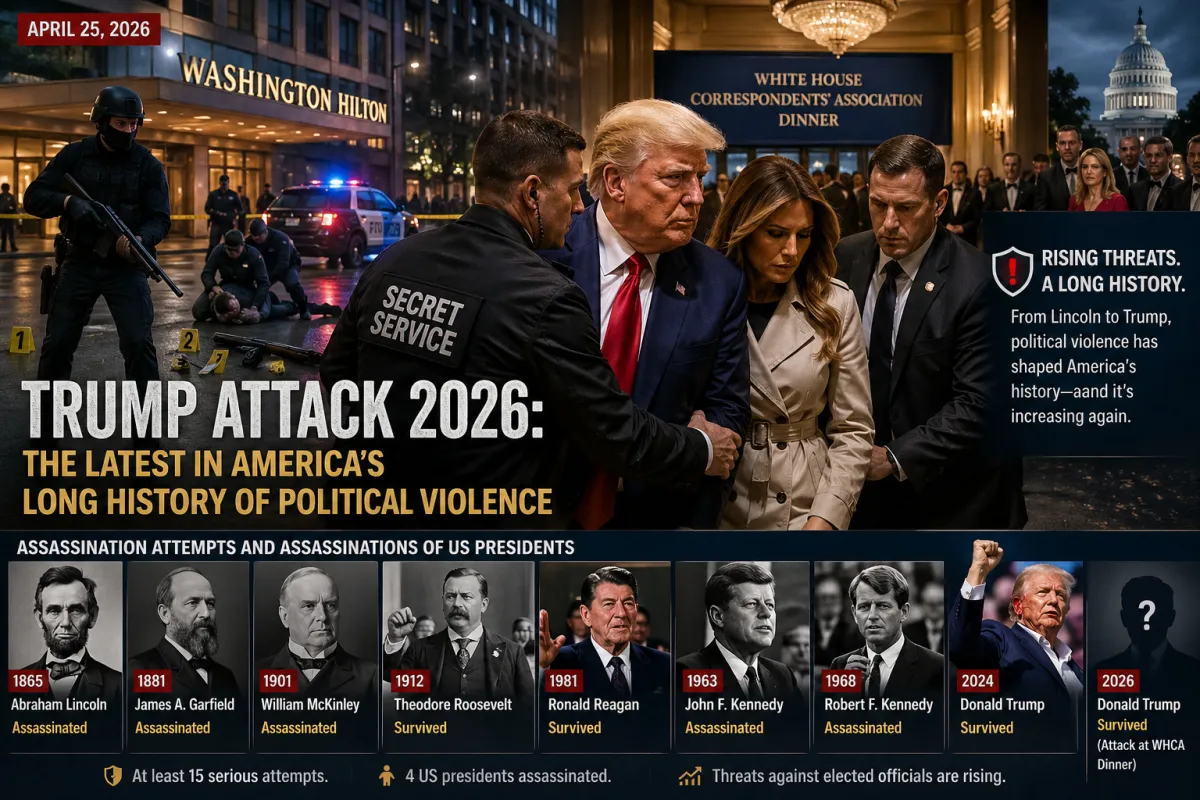
A recent security incident at the White House Correspondents’ Association dinner has reignited conversations around political violence and the long history of assassination attempts targeting American presidents and political leaders.
On April 25, 2026, Secret Service agents evacuated President Donald Trump and First Lady Melania Trump from the annual dinner at the Washington Hilton after an armed man reportedly opened fire on security personnel at a checkpoint inside the hotel. The suspect, identified as Cole Tomas Allen of California, was arrested at the scene after being subdued by security officers. Authorities stated that he was carrying a shotgun, handgun, and knives and had apparently been staying at the hotel where senior political officials and members of the media were gathered.
The incident has raised fresh concerns about political extremism, public safety, and the broader climate of polarization in the United States. Trump later told reporters that he believed he had been the intended target of the attack.
The Washington Hilton itself carries historical significance in the context of presidential security. In 1981, President Ronald Reagan was shot and wounded outside the same hotel during an assassination attempt carried out by John Hinckley Jr. That attack became one of the most well-known incidents of political violence in modern American history.
The latest incident also follows two assassination attempts against Trump during the 2024 presidential campaign season. In July 2024, Trump was injured during a shooting at a campaign rally in Pennsylvania that left one attendee dead and several others wounded. Later that year, another armed suspect was arrested near Trump International Golf Club in Florida after being discovered hiding near the property while Trump was present.
Historians and political analysts note that political violence has long been woven into American history. According to the Congressional Research Service, at least 15 direct assaults against presidents, presidents-elect, and presidential candidates have occurred over the course of U.S. history, resulting in multiple deaths.
The first U.S. president to be assassinated was Abraham Lincoln in 1865. Presidents James Garfield and William McKinley were also assassinated while in office, and President John F. Kennedy’s assassination in 1963 remains one of the most defining moments in modern American political history.
Other presidents and political figures survived assassination attempts, including Theodore Roosevelt, who famously continued delivering a speech in 1912 after being shot in the chest during a campaign event in Milwaukee. Roosevelt’s eyeglass case and folded speech manuscript reportedly slowed the bullet enough to save his life. His response became one of the most dramatic moments in presidential campaign history.
The article also highlights how shifting political tensions and deepening divisions have intensified concerns in recent years. The January 6, 2021 attack on the U.S. Capitol, escalating threats against elected officials, and repeated incidents involving political figures have contributed to growing fears about democratic stability and civic discourse in the country.
Observers point to increasing polarization, online radicalization, and widespread distrust in institutions as factors contributing to the current environment. The combination of political rhetoric, media fragmentation, and ideological extremism has created conditions where threats and violence are becoming more visible in public life.
The recent attack has once again drawn attention to the challenges facing security agencies tasked with protecting public officials while preserving democratic openness and civic engagement. At the same time, it has renewed broader conversations about how political tensions are reshaping American society and public discourse.
Read more here: https://mypluralist.com/2026/04/26/trump-attack-2026-history-of-us-presidential-assassinations/#google_vignette