
In Memoriam: Walid Khalidi
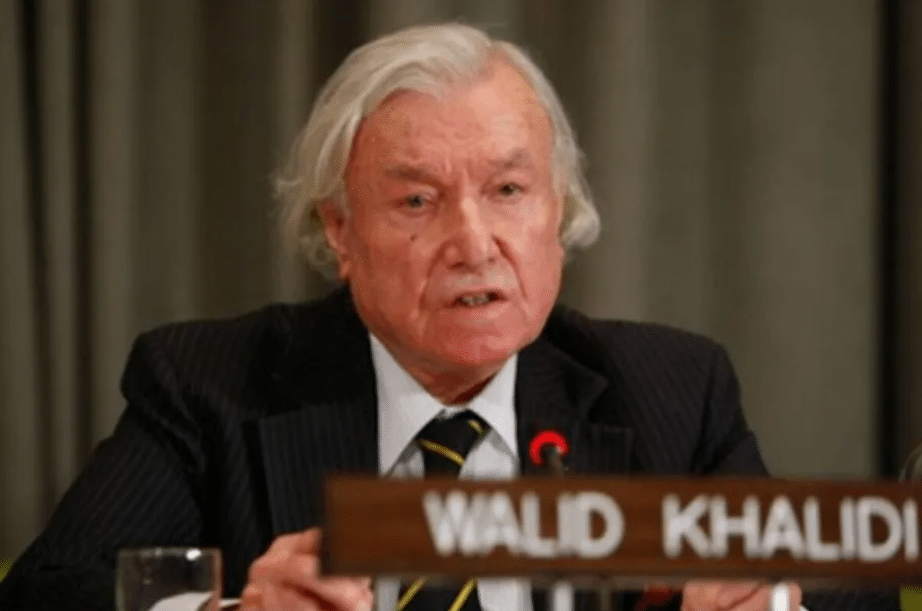
Walid Khalidi speaking at the UN General Assembly, November 30, 2009.
Professor Walid Ahmad Samih Khalidi, one of the most influential historians of Palestine, passed away peacefully in Cambridge, Massachusetts, at the age of 100. His life’s work, spanning nearly a century, leaves behind a profound intellectual and institutional legacy that continues to shape the study of Palestinian history and the broader understanding of the region.
Widely recognised as the historian of the Nakba, Khalidi dedicated his scholarship to documenting the displacement of Palestinians and preserving historical memory. His early research brought global attention to “Plan Dalet,” which he identified as a strategic framework for the mass expulsion of Palestinians. Decades later, his findings would be echoed and expanded upon by other historians, affirming the depth and foresight of his work.
His major publications, including From Haven to Conquest, Before Their Diaspora, and All That Remains, remain essential contributions to historical literature. These works provided detailed, evidence-based accounts that offered a Palestinian narrative often absent from mainstream discourse. Through meticulous research and documentation, Khalidi ensured that histories at risk of being overlooked were preserved with clarity and rigor.
Beyond his role as a historian, Khalidi was also a pioneering institution-builder. He founded the Institute for Palestine Studies, which has grown into a leading centre for research and scholarship. Under his leadership, the institute became a cornerstone for academic inquiry, fostering generations of researchers and producing work that continues to influence global conversations on Palestine.
Educated at Oxford and later a professor at the American University of Beirut, Khalidi combined academic excellence with a deep engagement in political thought. His 1978 essay, “Thinking the Unthinkable: A Sovereign Palestinian State,” introduced one of the earliest articulated frameworks for a two-state solution, reflecting his ability to connect historical understanding with contemporary political realities.
His life was also marked by displacement and resilience. After the 1982 Israeli invasion of Lebanon, which destroyed his home and personal library, Khalidi relocated to the United States. There, he continued his academic and intellectual work, including teaching at Harvard University, while remaining closely connected to the question of Palestine.
In his later years, Khalidi devoted significant effort to preserving the Khalidi Library in Jerusalem, a collection of rare manuscripts representing centuries of cultural and intellectual heritage. His commitment to safeguarding this legacy reflected a broader dedication to history, knowledge, and continuity across generations.
Those who knew him often described him as a scholar of remarkable precision and discipline, a teacher who demanded rigor, and a thinker deeply committed to truth. Even in his final years, he remained intellectually active, continuing to write and reflect on historical and contemporary developments.
Walid Khalidi’s legacy endures through his writings, the institutions he built, and the generations of scholars he influenced. His work stands as a testament to the enduring importance of historical inquiry and the responsibility of preserving memory in the face of change.