
Elise Jarvis
Director of Projects & Senior Fellow of The Trebuchet Academy, Summer 2026
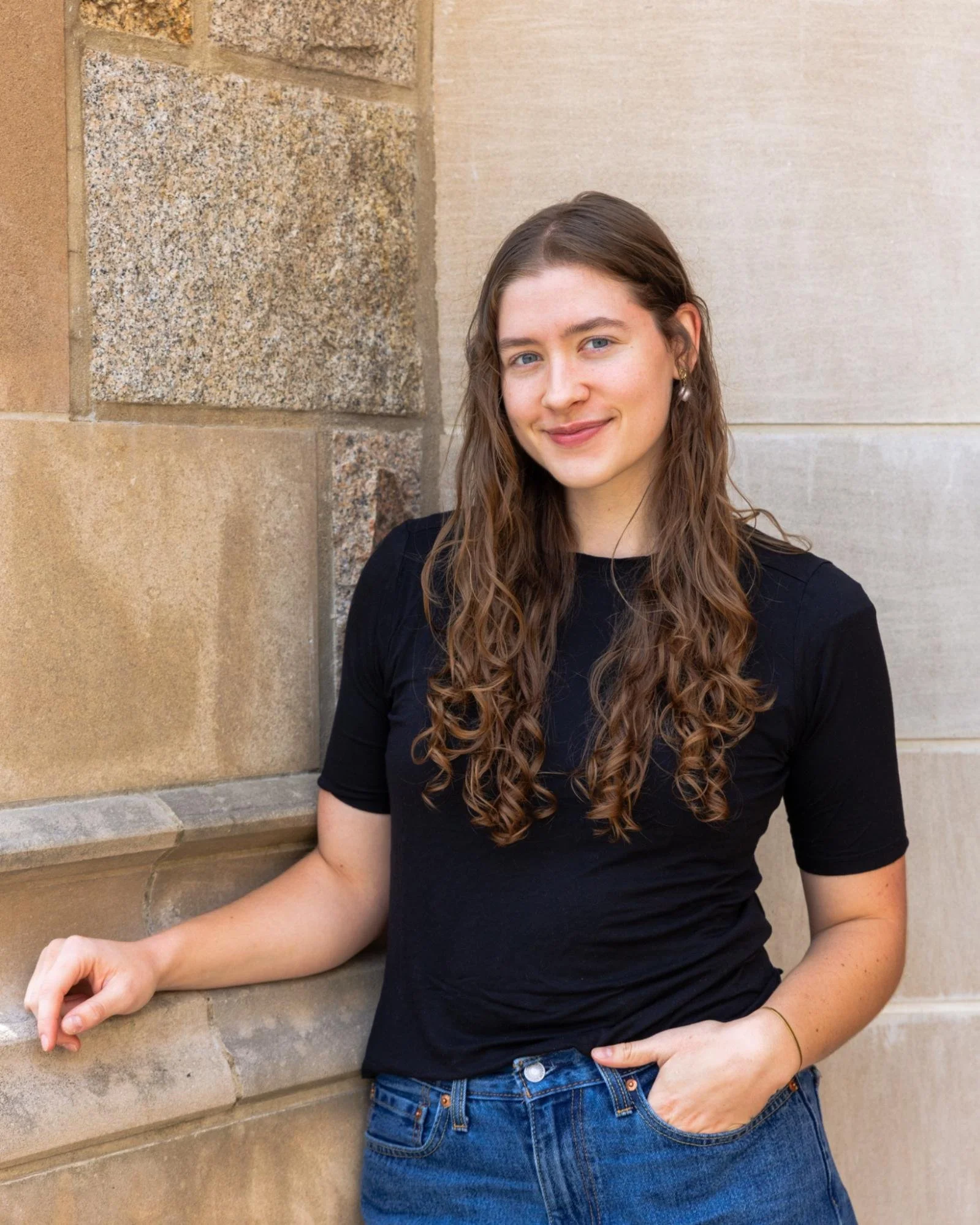
Sherman calls her his factotum. His ramrod. Elise professionally calls herself Director of Projects — though she has learned to hold that title loosely, since Sherman has a habit of finding better words.
She joined The Trebuchet in the spring of 2026 to bring coherence to what she describes as “the absolute vast genius that is Sherman and The Trebuchet.” As the active community launches into its next era as a self-sustaining synergistic institution, Elise oversees operations and assists Sherman with his gen-AI deliverables.
Speaking of an AI system, Elise Jarvis does her best to be the J.A.R.V.I.S. to Sherman’s Iron Man. Sherman, still recovering from spinal surgery last winter, wears a SpinalStim™ device for part of each day. With the device around his torso and its central unit resting below his chest, he bears more than a passing resemblance to Marvel's Tony Stark — though with even better hair, Elise would add.
Elise is a junior at Boston College studying International Studies with a concentration in Ethics & Social Justice, and a minor in Data Science. She is originally from Redwood City, CA — Silicon Valley — where her interest in tech ethics took root before her family relocated to Salt Lake City, UT, where she subsequently fell in love with the Wasatch Mountains.
She is also one of Sherman's “avatars” — his name for the Summer 2026 Fellows — once more bringing to life the vision of the mentor-mentee relationship at the heart of what Sherman does.
Her capstone research this summer follows questions of state sovereignty in the age of AI and big tech. Hoping to ground a broad topic in something tractable, she has chosen South Korea's "Framework Act on the Development of Artificial Intelligence and Establishment of Trust" as a focused case study — one that will travel well into her fall semester abroad at Seoul National University.
Her writing extends this work. She has served as an opinion columnist for The Heights, Boston College's foremost newspaper, and was first published in the Salt Lake Tribune in 2022 with a provocative op-ed on sex education in Utah public high schools — or, rather, the lack thereof. She now hones her AI ethics and policy lens on her Substack, Human in the Loop.

Elise was training to be a professional ballerina when, at 15, an ankle injury required trajectory-changing surgery. During recovery she discovered other passions; dance became therapy rather than a promising career. She has since healed and serves on the leadership board of the Dance Organization of Boston College — from hula to ballet, 18th century cotillion to hip-hop, she’s always found a way to be on stage or looking up at one.
In the wake of the pandemic and during her ankle recovery, Elise side-stepped into new territory where she found fulfillment in advocating for social justice reforms — another reason she feels deeply aligned with The Trebuchet’s initiatives. She led student efforts in the Salt Lake City School District to create spaces of bias reflection and advocate for district policies promoting racial justice, sitting as a panelist and consultant for the Utah Civic Learning Collaborative.
Through a different medium of civic service, from October 2023 to May 2025, and after her first year at university, Elise served as a full-time missionary in Portugal for the Church of Jesus Christ of Latter-day Saints. To Elise, her faith is not another container of life; it is the music that sustains the motion. And, to her, even the temporal things of this world are spiritual. She writes about the experience directly, in her application for her current role at The Trebuchet:
We didn't use the internet. We had messaging, scripture, and map apps, and that was essentially it. On long walks to teach lessons, my companion and I would reason through questions we couldn't look up — theological, scientific, sometimes trivial — and discover, twenty minutes in, that we had been arguing toward a real answer rather than retrieving one. I loved that companion, that walk, that process, the way I loved a hard professor or a demanding ballet director.
I came home to Boston College in the fall of 2025 and found generative AI everywhere, including in my own hands. I watched classmates use it to shortcut the reasoning I had just spent eighteen months learning to love. What I have been working out, slowly, is how to use these tools as companions along the walk rather than as replacements for walking.”
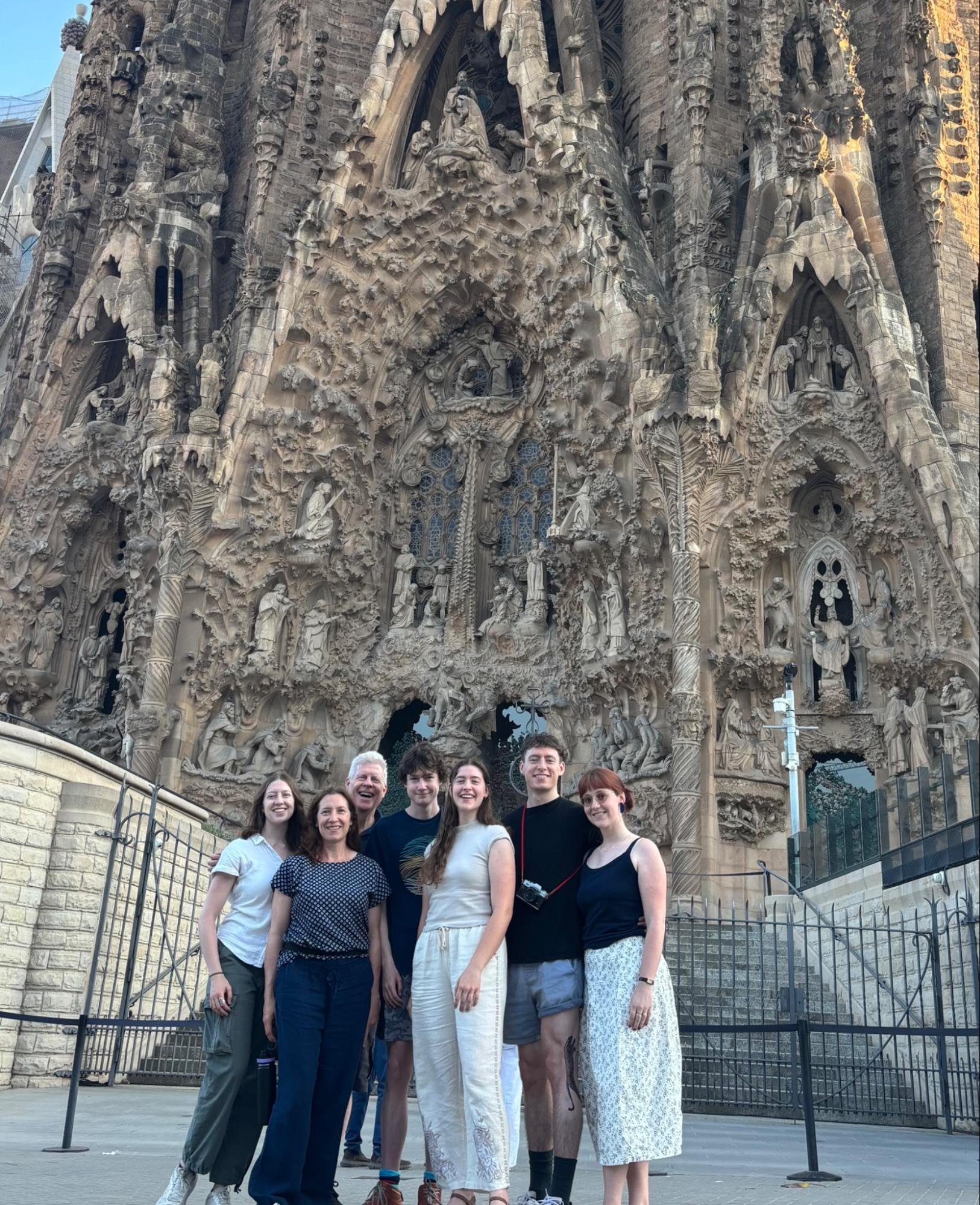
Elise owes this intellectual curiosity to her parents who love to live life in a state of awe and a spirit of action. Her Brazilian-British-American mother and L.A.-born father also notably instilled within her a strong work ethic and a hunger for adventure. From a 25-mile bike ride in Guilin, China with four kids and limited Mandarin capabilities to an extreme hike in the fjords of Norway, her mother's motto provides an illustration for how they taught Elise to live: "why walk when you can run?" That mindset along with her mother’s unfailing remark to those hearing of Elise's dancing for the first time — “Elise was dancing before she could walk” — illustrates something true about who she is: always moving forward, with a little bit of swing.
From Elise, on meeting Sherman:
I met Sherman through Zach Braiker — who has become an indispensable mentor in his own right — and through a recruitment website. When Sherman and I first walked around the Chestnut Hill Reservoir with his dog, Remi, I found him surprisingly — because just look at what he’s done and the people he knows! — down-to-earth. Within an hour we had made upwards of five new friends — two of them dogs. He has a remarkable ability to find something worth being curious about in almost everyone he meets.
After our walk, we went to his home in Brookline, where I met Iris. What struck me was the evident mutual respect and love between them — family is clearly a grounding force. Sherman is constantly reading, advising, mentoring, and building, yet it is equally clear that none of it comes before the people he loves. Sherman is a man of decency and integrity.
What excites me most is his fervor for life and his urgency to apply knowledge in service of something meaningful. He serves as an ombudsman for the fellows — someone people trust to listen, challenge, connect, and guide. Sherman understands that genuine human connection is the breeding ground for ideas, initiative, and lasting impact. As he and Zach have taken to saying: “1 + 1 = 3.” I have yet to see Sherman become recalcitrant in the face of a challenge — unless the challenge is democratic backsliding.
I tend to leave each of our conversations with at least one new vocabulary word. (Can you guess which ones here were introduced to me by Sherman?)
Though a newer addition to The Trebuchet, Elise's connection to trebuchets began years before she ever encountered Sherman. As a child, she was introduced to them during one of her uncle's engineering workshops for his nieces and nephews. Together, they built and launched a trebuchet, and the model still sits in her garage today. Perhaps it is time to dust it off.
Research
Topic: USAID and the Greater Horn of Africa
Proposal: My research project is exploring what happens to a region when the aid that it has relied on for decades suddenly disappears. I am especially interested in how withdrawal shapes not just humanitarian outcomes, but broader competition for soft power influence that fills the vacuum left behind. My guiding question is: How can African countries that relied on USAID for years move forward in a world where that money is no longer an option, and who is positioning to shape what comes next? As case studies, I plan to examine Kenya, Somalia, and Sudan. All geographically neighbors that relied heavily on USAID, but with drastically different histories and primary issues. I will also draw on Ethiopia and Djibouti as secondary cases when examining whether China and other powers see this withdrawal as an opening. My main priority is to trace the throughline connecting three questions: what has been the tangible impact, who is stepping in to fill that space, and what genuine paths forward exist for governments that can no longer count on that money returning.
Collaborators: Kaushik Srivatsan
Mentors: James Intriligator